About Lipo Sculpt: Non-Surgical Aesthetics in the UK

Learn about Lipo Sculpt’s published service scope and customer-care approach, including clear communication, confidentiality and feedback. Find questions to ask when considering a provider.

Published approachClear communicationConsidered questions
Provider context

A closer look at Lipo Sculpt

Lipo Sculpt publishes information about non-surgical aesthetics, body contouring and wellbeing services in the UK. This page introduces that scope and explores how to read the business's published approach to customer care. It brings together the questions that matter when you are learning about a provider: what is being offered, how information is explained, what remains to be confirmed and how to make a decision that fits your circumstances.

An About page can give useful context before a conversation, but it cannot assess your individual needs. A name, a treatment description or an attractive photograph does not establish whether an option is appropriate for you. The most useful starting point is an understanding of the provider's published information alongside your own priorities and the details you still want explained.

The chapters below are a reading guide rather than a statement that every suggested practice has been independently audited. The short factual introduction and charter summary are drawn from official information. The remaining discussion offers ways to evaluate that information and prepare a considered enquiry. You can read it in order, choose a topic from the contents or move directly to the service overview when you want to explore a particular area.

Official source, reviewed 8 October 2026: Read the full About information.

Choose a topic in this guide
  1. The scope behind the name
  2. What the published charter contributes
  3. Information that separates choices
  4. Courtesy when a subject feels personal
  5. Keeping private matters in the right setting
  6. A recommendation needs an explanation
  7. Understanding non-surgical descriptions
  8. Reading service categories without assumptions
  9. Expectations deserve their own discussion
  10. The person providing care matters
  11. Practical access is individual
  12. Feedback as a specific conversation
  13. Photographs provide context, not verification
  14. A source and an opinion serve different purposes
  15. Policies belong beside practical decisions
  16. Comparing options on your own terms
  17. Choose the next page for your next question
Perspective 01

The scope behind the name

Body contouring, skin appearance and personal wellbeing can bring very different questions to the same website. One visitor may want to understand a treatment name they have encountered elsewhere. Another may be looking for an explanation of an unfamiliar option. Someone else may simply want to know where to begin a private conversation. Understanding that variety helps place the business's published range in context without assuming that everyone arrives with the same objective.

Use the Services page to orient yourself, then keep the category separate from a recommendation. A category organises information; it does not decide what an individual should choose. If a description seems relevant, the next useful question is why it might be relevant to your circumstances and what further assessment would be needed. You need not arrive with a technical explanation or a fixed treatment choice.

It can also help to distinguish an appearance concern from a question about symptoms or function. Those are different reasons for seeking information, even when a website discusses them near each other. Describe the issue in your own language and ask which type of conversation is appropriate. This About page does not establish a diagnosis or provide a route for urgent care. Its purpose is to help you understand the information surrounding an elective enquiry.
Perspective 02

What the published charter contributes

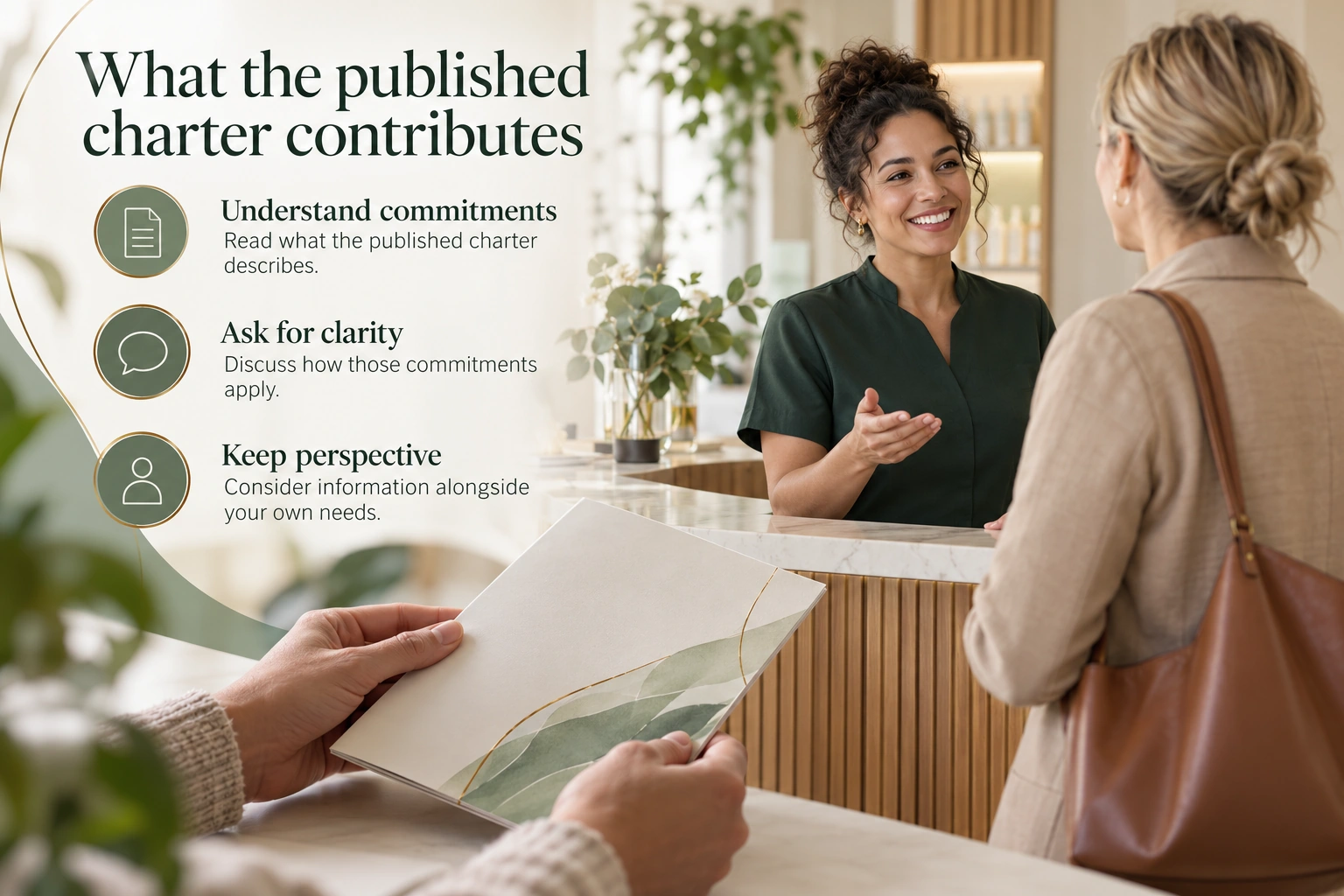
The official About page includes a customer charter whose themes include understandable information, courtesy, confidentiality, feedback and accountability. These are statements of the business's intended approach. They are useful context for a conversation, while remaining distinct from independently measured evidence of service performance.

When reading a charter, consider how a broad commitment might affect a real interaction. Clear communication could mean having an unfamiliar phrase explained in ordinary words. Courtesy could mean being able to express a concern without feeling that you must justify it. Accountability could mean knowing which question remains open and who should address it. These examples help you assess an experience; they are not additional promises made by this page.

You might keep one or two charter themes in mind rather than treating the whole document as a checklist to complete. If the explanation you receive is difficult to follow, ask for clarification of the particular point. If an answer differs from what you understood on the website, identify the difference and request an explanation. A published commitment becomes most useful when it helps frame a specific, reasonable question. The full charter remains available through the official About source linked below for readers who want to examine its wording directly.

Perspective 03

Information that separates choices

Useful information explains differences that affect a decision. Two descriptions may both mention skin appearance, for example, while referring to different purposes, settings or assessment needs. A reader should be able to ask what makes one option relevant and what makes another less relevant without having to interpret promotional language alone.

Look for an explanation of the concern being discussed before concentrating on the name of a device or technique. Ask whether the proposed option relates to the particular issue you described. If more than one approach is mentioned, request the reason for that comparison. An explanation can acknowledge uncertainty and still be helpful; certainty without an individual assessment should not be treated as a substitute for understanding.

You may find it useful to write down three separate statements: what you have read, what you think it means and what you need confirmed. This prevents an interpretation from turning into an assumed fact. It also gives the person answering your enquiry a clear starting point. Rather than asking whether everything on a page applies to you, choose the sentence or claim that influenced your interest. A focused question usually makes the distinction between general information and a personal recommendation easier to see, and leaves room for an answer that changes your initial view.

Perspective 04

Courtesy when a subject feels personal

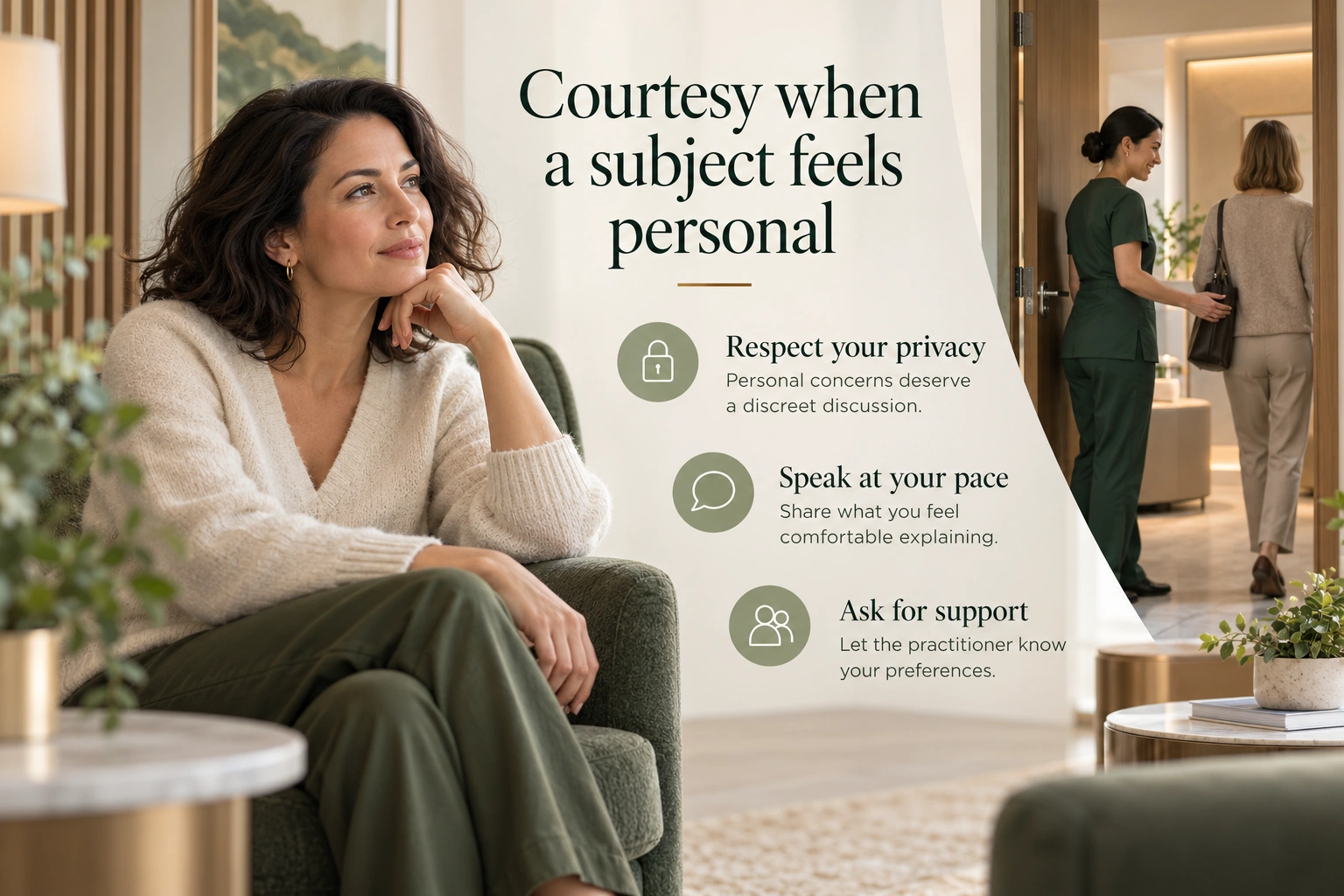
An aesthetic or wellbeing enquiry may involve something you have never discussed with a business before. You may feel comfortable naming the concern but less comfortable explaining its effect on your daily life. You may also prefer to begin with practical questions about the process before sharing more detail. These preferences can be expressed plainly without needing a lengthy explanation.

Think about what would make the conversation easier for you. That might include a quieter setting, a slower explanation, time to take notes or an opportunity to return to a question. Ask whether your preference can be accommodated rather than assuming a particular arrangement is available. This page does not confirm staffing, accessibility facilities or a guaranteed format for every discussion.

Courtesy also matters when a visitor is uncertain or decides to pause. An enquiry can end with more information rather than a booking. You can say that you are still comparing possibilities or that you need to discuss practical arrangements with someone close to you. Consider whether the answers help you understand the issue without making you feel obliged to reach a conclusion immediately. A calm pace and straightforward language are useful things to request, particularly when the subject itself is sensitive or unfamiliar.

Perspective 05

Keeping private matters in the right setting

Confidentiality is one of the themes in the published customer charter. When considering that commitment, distinguish a private discussion from the audience for a public social interaction. A comment on a social profile can be visible to other people, and the platform may have its own rules about how information is handled. The fact that a profile belongs to a business does not make every interaction private.

For an initial enquiry, consider what information is necessary to explain the topic. A general description may be enough to ask where a more detailed conversation should take place. Avoid posting personal records or another person's details publicly. If photographs or further background are requested later, ask what channel is appropriate and why the information is needed before sharing it.

The Privacy overview on this website explains the distinction between these informational pages and the official source's data-handling descriptions. It does not certify the privacy of every external service or describe a local account system. Reading the relevant policy at the destination where you provide information gives you better context than relying on a general statement about confidentiality alone. If the explanation leaves a practical question unanswered, identify that question and raise it through the approved contact route before proceeding.

Perspective 06

A recommendation needs an explanation

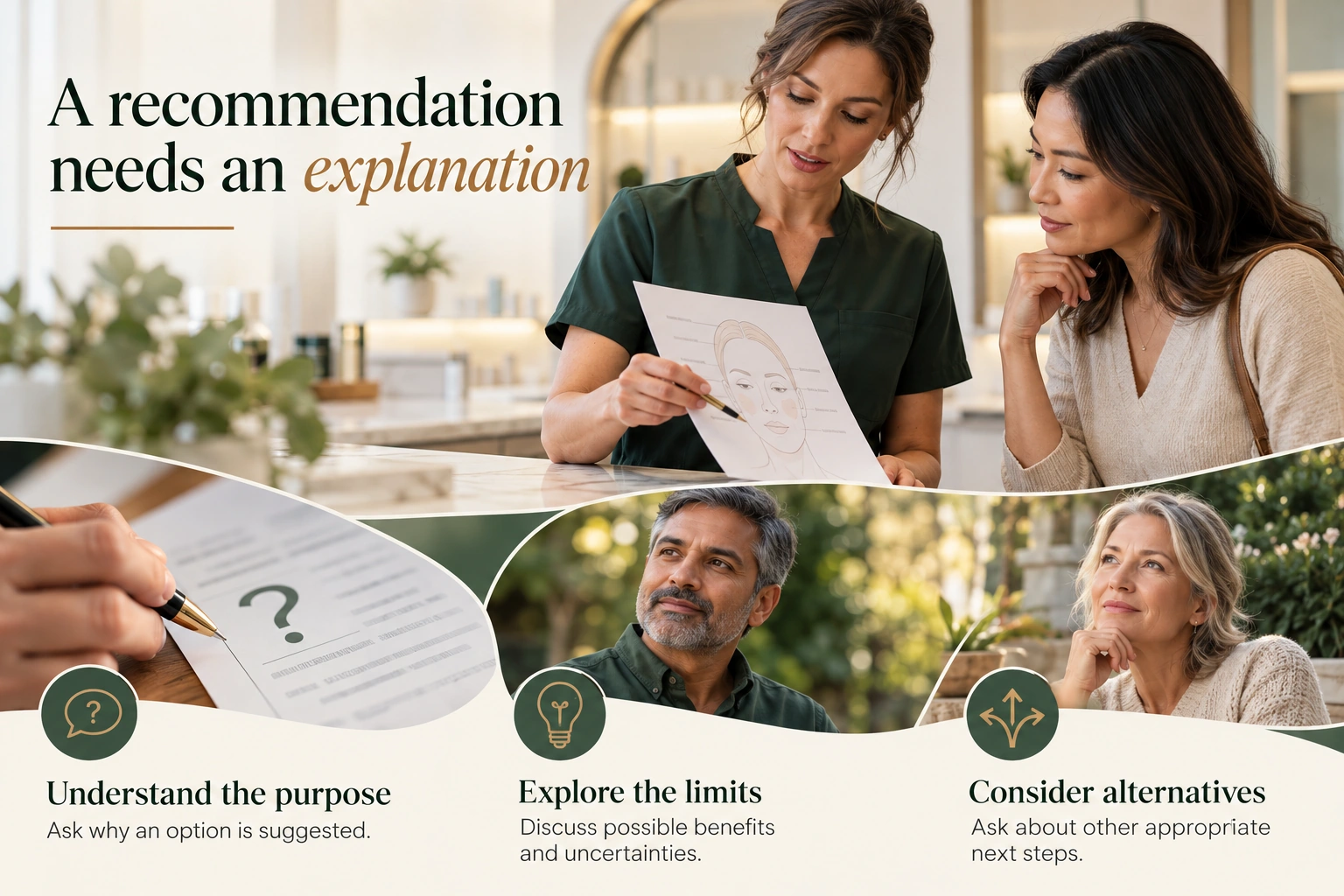
A recommendation is easier to consider when you understand the reasoning behind it. That includes the concern it is intended to address, what assessment informed the suggestion and which limitations remain relevant. A treatment name alone cannot provide that context, even if you have seen the same name on several websites.

You can ask the person discussing an option to connect their explanation to what you said matters most. For example, if you described a particular appearance concern, ask which part of the proposed approach relates to that concern. If the answer introduces an additional treatment, ask why it has entered the discussion. These questions do not require you to challenge every statement; they help you follow the logic of the proposal.

Keep the explanation separate from the practical arrangements and cost. An option may be understandable while still raising questions about appointments, affordability or time to consider it. Equally, a convenient arrangement does not establish suitability. Taking each part in turn helps avoid a decision based on whichever detail feels simplest. You can ask for a point to be explained again, note what remains uncertain and return to it later. This page offers a way to think about recommendations, rather than endorsing a particular plan or claiming that one approach is appropriate for every visitor.

Perspective 07

Understanding non-surgical descriptions

Non-surgical is a broad description of an approach, not a complete account of its risks, suitability or likely outcome. It should not replace questions about what a particular treatment involves. A visitor who recognises the category may still need an explanation of the procedure, assessment and practical implications before deciding whether to explore it further.

When reading, notice whether several different methods are grouped under the same label. They may share a broad category while requiring different discussions. Ask what the label means for the option you are considering, rather than carrying assumptions from another treatment into the conversation. The absence of surgery does not justify assuming that every option has the same experience, restrictions or recovery requirements.

This page does not provide preparation instructions, aftercare advice or a list of medical exclusions. Those matters require information relevant to the actual option and your circumstances. You can ask who will explain them, at what point that explanation will happen and how you should raise further questions. If your reason for seeking information includes a health concern, describe it accurately and seek an appropriate professional assessment rather than relying on the general category. A clear definition is helpful; it is still only the beginning of an informed discussion.

Perspective 08

Reading service categories without assumptions

The website's service overview offers a way to navigate a broad subject. Read category names as signposts to information. A heading about body contouring may help locate a topic, but it should not be treated as a conclusion about the cause of a concern or the result a treatment will produce. The same distinction applies to skin appearance and wellbeing subjects.

If several categories seem relevant, start with the issue rather than choosing whichever title sounds most appealing. Describe what you have noticed, what you want to understand and whether you have already sought advice. You can ask how the categories differ and which conversation would help clarify your question. There is no need to turn a general interest into a detailed treatment brief before making contact.

Some readers prefer a short overview; others want to examine every page. Either approach can leave unanswered questions. Keep a note of the specific description that prompted your interest so it is easy to locate again. If you later receive an explanation that differs from your reading, compare the actual wording instead of relying on memory. Categories organise a website for many people; an individual conversation should connect the information to the person asking. That connection requires more than matching a concern to a heading.

Perspective 09

Expectations deserve their own discussion

People can use the same word to describe very different expectations. Improvement might mean a visible change, an easier routine, a better understanding of an option or simply a decision about whether to continue exploring it. Before discussing a plan, consider which meaning matters to you and how you would explain it without relying on a broad promotional phrase.

Ask what an explanation can establish and what it cannot predict. If an image or example influenced you, identify the feature you noticed and ask whether it is relevant to your circumstances. A comparison photograph or another person's account cannot confirm your individual outcome. This page does not offer a results guarantee, a standard improvement percentage or a timetable for change.

You may also have expectations about communication, appointment arrangements and cost. These deserve separate questions because a discussion of treatment does not automatically answer them. Note which answers concern the service and which concern practical arrangements. A realistic view includes space for limitations, alternatives and uncertainty. If an expectation is particularly important to your decision, make it explicit early enough for it to be discussed. Understanding that an option may not meet your priority can be useful information, even when it leads you to pause or choose another route.

Perspective 10

The person providing care matters

An About page cannot replace information about the person who would carry out an actual treatment. A general business description, a uniform in a photograph or the name of a technique does not establish an individual's training or responsibilities. If those details matter to you, ask about the proposed provider directly.

Useful questions might concern who will assess your suitability, who would provide the treatment and who would answer questions afterwards. Ask how their relevant experience or qualifications can be checked rather than drawing conclusions from imagery. These are suggestions for an enquiry, not confirmation of a particular staffing structure, qualification or professional registration at Lipo Sculpt.

Keep the information specific to the service and appointment under discussion. A statement about a business as a whole may not answer a question about one person's role. If the proposed provider changes, consider whether you need to revisit the details that influenced your decision. You may also want to understand how a question is passed to the right person when it cannot be answered immediately. Knowing the role behind an answer can be more useful than receiving a confident answer without context. This page deliberately avoids invented staff biographies, personal credentials or claims about a team that have not been verified.

Perspective 11

Practical access is individual

Practical arrangements can affect whether an otherwise interesting option is feasible. Travel, privacy, work, caring responsibilities and communication preferences may all influence your next step. Consider which details you would need before arranging anything, then raise those details as questions rather than assumptions about what the business can provide.

A broad description of UK services does not confirm a specific setting or appointment near you. Ask about the actual location and arrangement relevant to the option discussed. If an alternative setting would matter, explain your circumstances and request information about availability. This website does not display a clinic directory or promise that every treatment can be delivered in every setting.

Think beyond the date itself. You may need to understand arrival arrangements, the time set aside for the appointment or whether another person can accompany you. Ask which details can be confirmed now and which would depend on the eventual plan. An early practical enquiry can prevent you from organising travel or other commitments around an assumption. It also helps separate interest in a service from readiness to arrange it. The aim is to understand what would actually be involved for you, without adding an unverified address, facility claim or availability promise to this page.

Perspective 12

Feedback as a specific conversation

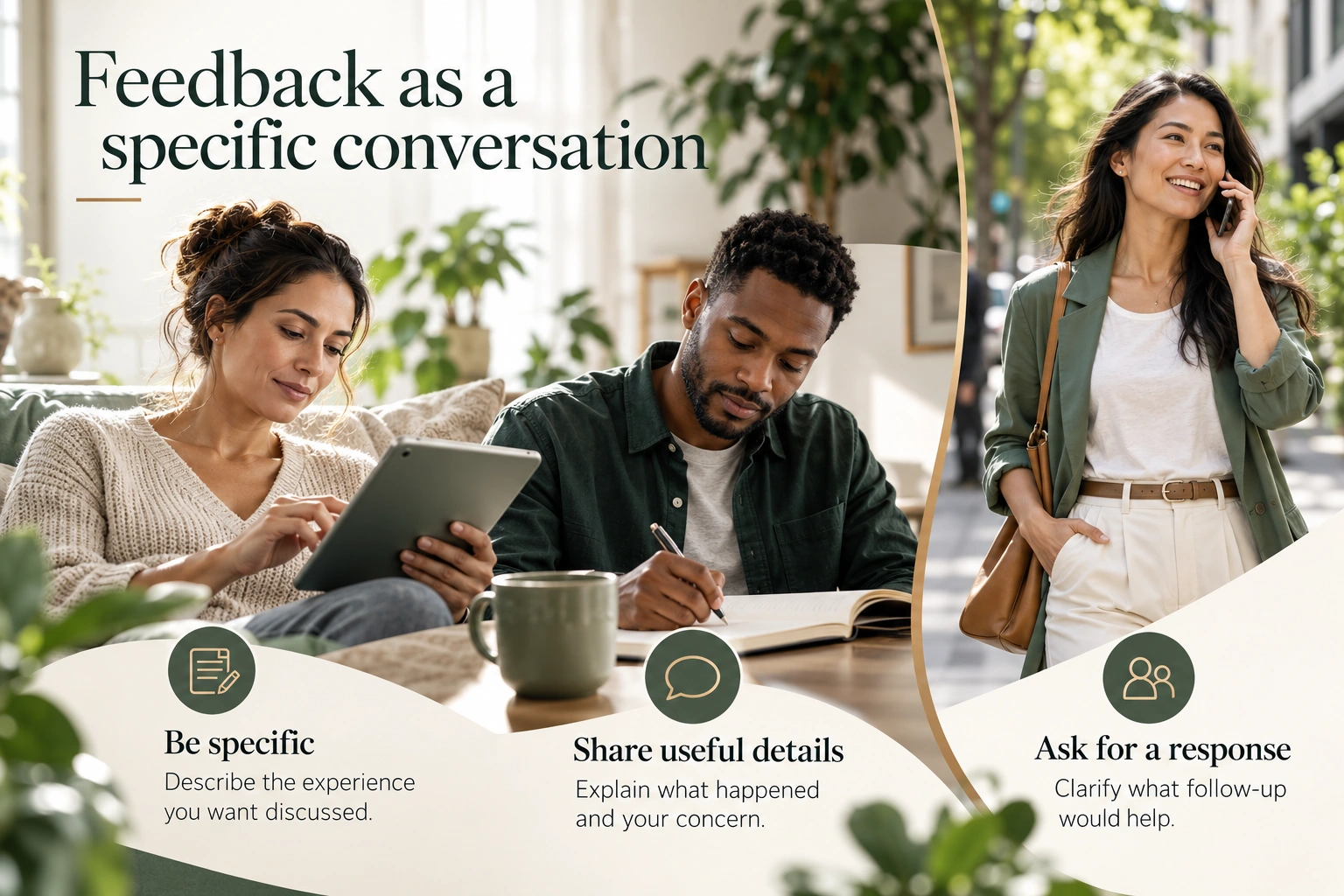
The official charter includes feedback and accountability among its themes. If you want to raise a concern, a clear description of the issue can help distinguish it from a general comment. Think about what happened, what information you understood at the time and what response you are now seeking. You need not turn the first contact into a complete history.

Separate the observable event from your interpretation. For example, a detail may have been unclear in an explanation, or a practical arrangement may differ from what you expected. Naming the point precisely gives the recipient something concrete to address. If you have relevant correspondence, retain it and ask which information should be provided through an appropriate channel.

This page does not invent a complaints deadline, escalation procedure or guaranteed response time. Ask Lipo Sculpt how the particular concern should be handled and how you can recognise the next step. Acknowledging a message, explaining an issue and resolving it are different things; you can ask which has occurred if that is unclear. Keep a note of any answer that changes your understanding. Feedback is most useful when it identifies the matter to be addressed and leaves room for clarification, rather than relying on broad judgments about the whole service.

Perspective 13

Photographs provide context, not verification

An image can make a page easier to understand by illustrating a conversation or a treatment setting. It cannot independently establish who works for a business, where an appointment will occur or what equipment will be used. Captions on the new pages identify reused imagery as illustrative so that an attractive scene is not mistaken for a verified photograph of a particular appointment.

Look at what an image is being asked to communicate. A picture of two people talking may support a topic about communication, while offering no evidence about the people who would speak with you. A photograph of a device does not answer questions about its use in your case. A visual example of appearance should not be read as a personal forecast.

When an image influences your interest, bring the relevant question back to the description and the provider. Ask whether the feature you noticed relates to the service under consideration and what can be confirmed about the actual setting. You can appreciate the presentation while keeping those distinctions clear. This is particularly helpful when comparing several websites whose photographs may look similar. The strongest basis for a decision is the information that can be explained and checked for the actual service, rather than the impression created by the page's visual style.

Perspective 14

A source and an opinion serve different purposes

Official pages help establish what a business currently publishes. They do not independently verify every claim made about a service. A personal account can describe someone's experience, but it does not show that the same experience will apply to another visitor. Recognising these different roles makes it easier to assess information without treating every statement as equivalent evidence.

Consider who is making a claim, what it refers to and whether it can be checked. A practical detail about a consultation can be confirmed with the business. A statement about an individual outcome needs a different kind of context. A general expression of satisfaction may tell you little about the specific concern you want to discuss. Avoid combining these into a single impression that seems more certain than the underlying information.

You can keep a simple record of the source beside a point that matters to you. Note whether it comes from an official page, an answer to your enquiry or another person's account. If two statements appear inconsistent, ask about the difference rather than selecting the more reassuring one. This page reuses verified business facts but does not expand unverified testimonials or turn published marketing into an independent endorsement. That boundary helps you see what the website can usefully explain and what still deserves further investigation.

Perspective 15

Policies belong beside practical decisions

Privacy information and booking terms can be easy to overlook when your attention is on a service. They become more relevant when you are deciding whether to provide personal information, make a payment or arrange an appointment. Consider reading the appropriate document before that action, while you still have time to ask about anything you do not understand.

The Privacy and Terms pages on this website provide source-linked overviews and reading guidance. They are not approved replacements for the full official documents. Follow the source link when you need the complete wording, then identify the part connected to your intended action. A short overview can help you navigate a topic, but it should not be treated as the entire agreement or an assurance about data handling at another destination.

If a practical explanation and a published document appear to differ, ask which wording applies and why. Retain the answer with the relevant booking information if you later proceed. This About page does not add a refund promise, cancellation rule or privacy commitment. Its role is to place those questions in the wider decision, so that understanding the provider includes the conditions surrounding an action as well as the description of the service itself.

Perspective 16

Comparing options on your own terms

Comparison is easier when you decide which questions matter before reading too many different descriptions. Otherwise, a changing mixture of images, phrases and offers can make each page feel persuasive for a different reason. Choose a few priorities that reflect your circumstances, such as clarity of explanation, understanding of limitations and the practical information needed to consider an appointment.

Apply the same questions to each option you examine. Note which answers are specific and which remain general. If a provider has not answered a point, mark it as unresolved rather than treating the absence of information as reassurance. You do not need a complex scoring system; a short list of answers and open questions can reveal what still matters.

Avoid forcing a conclusion just because you have spent time researching. Reading can help you recognise that you need more information or that your original preference has changed. An option that sounds attractive in general may not fit your practical priorities. Equally, a simple explanation may be more useful than a long description that leaves the key question untouched. This page offers context for evaluating Lipo Sculpt's published approach, while leaving the comparison and eventual decision with you. A thoughtful enquiry is a valid outcome of research, even before any booking is considered.

Perspective 17

Choose the next page for your next question

Once you have considered the business context, decide what information would help next. The Services page is useful for locating the area you want to explore. The Book Consultation page explains the published telephone-consultation information and offers optional preparation guidance. Contact Us provides the approved telephone and social destinations for an enquiry.

If your question concerns personal information, read the Privacy overview and the linked official policy. If it concerns a booking condition, move to the Terms overview and examine the full source. Choosing the page that matches the question can be more effective than rereading every part of the website. You can return to this About page when you want context for the provider's published approach.

Before taking an action, identify what you know and what remains open. You may have a clear topic to discuss without having chosen a treatment. You may understand an option but still need practical details. You may simply decide to continue reading. None of these stages requires a claim about a future outcome. Keep your own priorities visible, ask for explanations where needed and allow the next step to follow from the information you actually have. Learning about a provider should leave you better able to ask useful questions and consider the answers.